
🗓️ June 30, 1896: Otto Lilienthal Patents the Glider That Took Off Before Engines Did

“Before the Wright brothers flew, Lilienthal soared.”

✈️ A Leap Without a Motor

On June 30, 1896, German engineer and daredevil dreamer Otto Lilienthal was granted U.S. Patent No. 558,416 for a flying machine—a weight-shift controlled glider that took humanity one graceful swoop closer to powered flight.
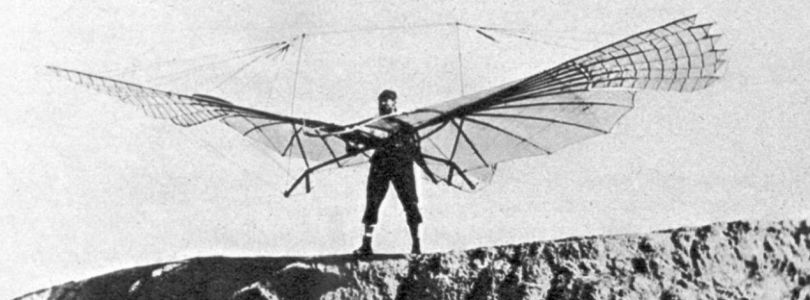
Using bird anatomy as his inspiration, Lilienthal’s glider had curved wings and a harness system that let him shift his body weight to steer. These weren’t drawings-for-the-future types of inventions—Lilienthal actually flew them. He conducted over 2,000 glides from artificial hills he built himself, typically crashing only occasionally (which, for 1890s aviation, was a solid average).

📜 Why It Mattered

  • Flight as fact: Lilienthal proved humans could fly before powered engines existed—he flew up to 800 feet at a time.
  • Design legacy: His gliders inspired the Wright brothers, who cited him often and called him “the father of flight.”
  • Science in motion: He meticulously logged his flights, treating each like a physics experiment with feathers.

⚠️ A Tragic but Heroic End

Only two months after this U.S. patent was granted, Lilienthal was killed during a flight when a gust of wind threw his glider into a dive. His last words were reportedly, “Sacrifices must be made.”

That sacrifice wasn’t in vain. His meticulous work made it possible for others—namely two brothers from Dayton, Ohio—to take the leap from gliding to powered flight.

🧾 TL;DR Summary

  • Date: June 30, 1896
  • Inventor: Otto Lilienthal
  • Invention: Weight-shift controlled glider
  • Impact: Direct inspiration for the Wright brothers and a pivotal step toward modern aviation

📣 Final Thought

Before propellers spun and jet engines screamed, there was Lilienthal—running off a hill in a canvas wing, trusting physics and courage alone. On June 30, we celebrate the moment a man truly caught air, and history caught wind of a revolution.

Comments

Popular posts from this blog

💡 July 3, 1886: Karl Benz Drives the First Automobile

“Before road trips, traffic jams, and drive-thrus, there was one three-wheeled contraption—and a dream.” 🚗 The Day the Motor Age Began On July 3, 1886 , in Mannheim, Germany, Karl Benz took to the streets in the world's first true automobile: the Motorwagen . It was a three-wheeled, gas-powered contraption with a one-cylinder, four-stroke engine mounted on a wooden chassis—and it changed history. This wasn't just a glorified tricycle. The Motorwagen could reach speeds of 10 mph, and it had working steering, brakes, and even a rudimentary carburetor. While the ride was a little bumpy (and loud), Benz's invention proved that internal combustion could power personal travel. ⛽ Fueled by Innovation (and a Bit of Bravery) Patent No. 37435: Filed in January 1886, but the first public test drive was July 3. Self-propelled glory: No horse, no pedals, just pure mechanized motion. Historic passengers: Benz's wife, Bertha, later took the car on a 66-mil...

🗓️ July 8, 1963: Ampex Patents the First Video Tape Recorder for Home Use

“Before streaming, before DVDs, before ‘Be Kind, Rewind’—there was this.” 📼 Press Play on the Past On July 8, 1963 , Ampex Corporation was awarded U.S. Patent No. 3,099,754 for an invention that would quietly but completely reshape media consumption: the first practical home-use video tape recorder . Though it would take years to hit store shelves at a consumer-friendly price, this patent laid the groundwork for the glorious rise of the VCR. Before this, if you missed a TV show—tough luck. It aired once and vanished. But the Ampex system changed the game: magnetic tape could now capture full video signals, store them, and play them back on command. Suddenly, time-shifting was real, and broadcast television lost its grip on our schedules. 📺 How It Worked Magnetic tape: Recorded audio and video signals onto reels that could be rewound and reused. Analog innovation: Achieved relatively high-quality playback in a consumer-friendly format. Giant machines: Early v...

🗓️ July 1, 1913: The Zipper Gets a Makeover—and a Future

“From boots to bags to blue jeans—nothing zips along quite like this.” 🧵 The Reinvention of the Zipper On July 1, 1913, Swedish-American engineer Gideon Sundback was granted U.S. Patent No. 1,060,378 for his “Separable Fastener.” This was no minor tweak—it was the first truly functional version of what we now call the zipper . Earlier attempts, like Whitcomb Judson’s 1890s “Clasp Locker,” were clever but clunky. Sundback’s design introduced interlocking metal teeth and a slider mechanism that made opening and closing fabric smooth —and almost addictive. The modern zipper was born. 🧰 Why It Was Revolutionary Speed and simplicity: Much faster and neater than buttons or laces. Widespread utility: Used in boots, flight suits, dresses, tents, luggage—you name it. Cultural icon: Eventually became synonymous with cool—think leather jackets and blue jeans. 🧑‍🔧 A Zipper by Any Other Name... The term “zipper” didn’t appear until the 1920s, when B.F. Goodrich u...